

DBR and Mindfulness: Similar Attention, Different Clinical Purpose
/Paolo Imbalzano · Presenting Past Psychotherapy
This question comes up often, both from clients and from colleagues.
At first glance, Deep Brain Reorienting, or DBR, and mindfulness can seem to occupy similar territory. Both involve slowing down, paying attention, and noticing what is happening internally. It is understandable, then, that people ask whether DBR is simply another form of mindfulness, or whether both are doing the same thing under different names.
It is also a question I held myself for some time.
The distinction did not become clear to me all at once. It emerged gradually, through training, clinical experience, and observing what actually happens when trauma activation is approached through DBR. Over time, I came to see that although DBR and mindfulness both involve careful attention, they use attention in different ways and for different clinical purposes.
That is the distinction I want to explore here.
Similar on the surface, different underneath
Mindfulness is mainly an attentional practice. It helps a person notice thoughts, feelings, sensations and impulses in the present moment, often with more acceptance and less immediate reaction.
Some forms of mindfulness are also strongly body-based. Vipassana, for example, places considerable emphasis on bodily sensation, careful observation and staying with changing experience. In that sense, mindfulness is not simply cognitive or reflective. It can be deeply embodied.
DBR is different.
DBR is a trauma-processing approach. It is interested not only in what a person notices now, but in how the nervous system first registered threat, shock or relational injury when something overwhelming happened.
A simple way of putting it is this:
Mindfulness listens to what emerges and helps us stay with present-moment experience.
DBR positions attention earlier in the nervous system sequence, close to where orienting and shock first arise.
That difference matters.
Many people who come to therapy are already thoughtful and self-aware. They may have reflected deeply on their history, their relationships, and the patterns that keep repeating. Some have tried therapy before. Some have practised mindfulness, meditation, yoga, breathwork, or other forms of self-regulation.
These approaches may have helped. They may have brought more awareness, more language, or more capacity to pause.
And yet, something in the body can still react as if the danger is not fully over.
A person may know they are safe, but still freeze.
They may understand the origin of their anxiety, but still feel hijacked by it.
They may recognise a relationship pattern, but still find themselves reacting from fear, shame, collapse or urgency.
This is where DBR can offer something different.
Mindfulness listens to what emerges
In mindfulness, the emphasis is usually on listening to what emerges and learning to stay with it.
Sensations arise. Thoughts arise. Emotions arise. Discomfort, restlessness, numbness, resistance, pain or memories may appear. The practice is to notice, remain present, soften reactivity where possible, and develop a different relationship to experience.
For some people, this creates more space between stimulus and response. Instead of immediately becoming caught in anxiety, shame, anger or self-criticism, they may begin to notice:
“I am having this reaction.”
“My body is tightening.”
“There is fear here.”
“I am getting pulled into an old pattern.”
That can be an important part of therapy.
It can also be difficult. I remember how demanding this was in the early days of my own Vipassana practice. Staying with bodily sensation, especially when discomfort or emotional material begins to surface, is not always gentle or easy. It can require discipline, tolerance and a capacity to remain with experience even when part of the system wants to move away.
I have written more about this elsewhere, in a reflection on whether mindfulness is always helpful, especially when meditation begins to bring difficult emotional or bodily material closer to the surface.
For some people, this is useful and strengthening.
For others, especially where there is complex trauma, developmental trauma, attachment injury or dissociation, simply turning inward and staying with what emerges may not be enough. In some cases, it can even become overwhelming if the nervous system does not yet have enough safety, support or capacity.
Some clients become more aware of their distress without knowing how to process it. Others may use mindfulness to manage or contain experience, while the underlying trauma activation remains largely unchanged.
This does not mean mindfulness has failed. It means it may be working at a different level.
DBR positions attention before the shock fully arrives
DBR does not simply ask the person to observe anxiety, shame, fear, grief or anger once these have already appeared.
It pays attention to what happens before those more recognisable feelings arise.
This is one of the clearest differences between DBR and mindfulness.
In mindfulness, including body-based forms such as Vipassana, the practice is often to listen carefully to what emerges and remain present with it.
In DBR, we are not primarily asking the client to stay with whatever emerges. We are trying to position attention at a very specific point in the sequence of activation: just before the shock response fully arrives, and before the later affect becomes dominant.
This may involve noticing a subtle bracing in the neck, a change around the eyes, a moment of startle, a freeze, a collapse, a shift in breathing, or a sense that the body is beginning to orient towards threat before the mind has fully understood what is happening.
The nervous system often registers danger before we can think clearly about it. Before there is a story, there may be orienting. Before there is emotion, there may be shock. Before there are words, there may be a bodily preparation for threat, loss, humiliation, abandonment or attack.
DBR gives us a way of working with that earlier sequence.
Mindfulness may help someone say:
“I notice fear in my body.”
DBR may help us ask more precisely:
“What happened just before the fear? Where did the system first orient? Where is the shock beginning to arrive? Can we stay close to that point, gently and precisely, without pushing into too much affect too quickly?”
That is a different clinical question.
The aim is not to intensify the experience or flood the person with emotion. It is to support stability while the earlier shock response begins to clear. The affect may come later, but the work does not need to rush there.
This is one of the reasons I find DBR clinically valuable. Rather than moving directly into emotional content, it gives attention to the earlier moment where the system first organised itself around threat.
Shock first, affect later
In trauma therapy, affect can become overwhelming if the work moves too quickly.
Fear, grief, shame, rage, helplessness, collapse or relational pain may all be important. But if the system is taken too quickly into the full emotional charge, there may be intensity without integration.
DBR approaches this differently.
The emphasis is on stability and gentle clearing. The therapist and client attend first to the orienting and shock sequence, before moving into the fuller affective material.
The sequence matters:
Orienting first.
Shock first.
Affect later.
In real clinical work, this sequence is not always neat or linear. Human beings are not mechanical systems. But the principle is important: DBR tries to work close to the point where the nervous system first organised around threat, rather than waiting until the full emotional cascade has taken over.
That difference may sound subtle, but clinically it can be significant.
DBR is not simply a relaxation technique
Because DBR can look quiet from the outside, it is sometimes misunderstood as a calming or meditative practice.
It is not primarily that.
DBR can be regulating over time, but it is a trauma-processing method. During a session, the client may appear still, but internally there may be significant processing of shock, fear, grief, rage, shame, collapse or relational pain.
This is one reason why pacing matters so much.
In my practice, I do not see DBR as a stand-alone technique applied mechanically. I integrate it within a relational, body-aware and formulation-led psychotherapy process. The therapeutic relationship, the client’s history, their window of tolerance, their capacity for integration, and the wider context of the work all matter.
For some clients, it may be important to establish more stability before working directly with traumatic material. For others, DBR may be introduced gradually, alongside other ways of supporting regulation, embodiment and relational safety.
The question is not simply:
“Can we use DBR?”
The more important question is:
What does this person’s nervous system need, at this point in the therapy, for the work to be safe, precise and useful?
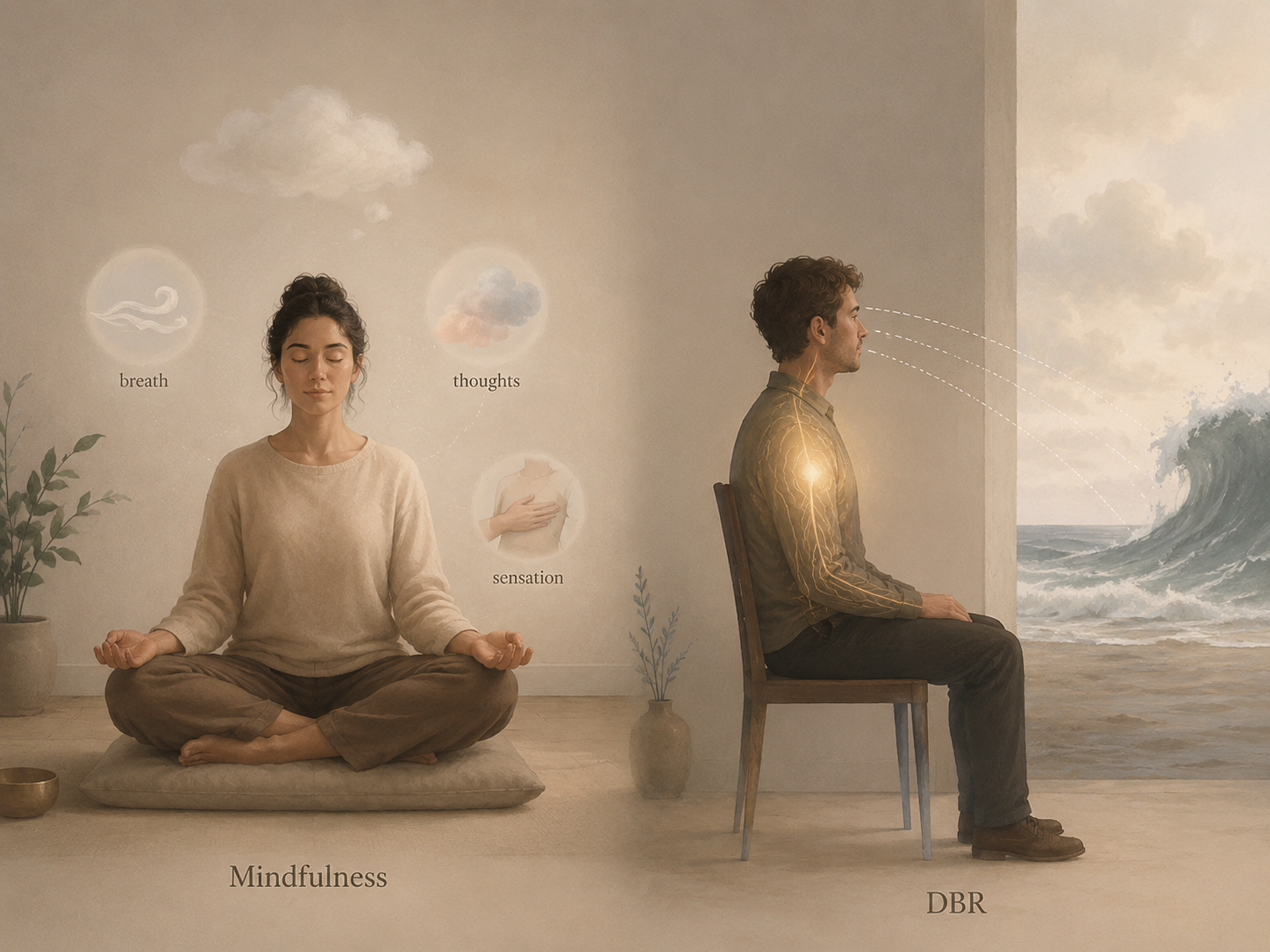
Mindfulness listens to what emerges; DBR attends earlier in the sequence, where the nervous system first begins to orient towards threat.
Observing experience and processing unresolved activation are not the same
One of the key differences between mindfulness and DBR is the distinction between observing experience and processing unresolved activation.
Mindfulness can help a person change their relationship to experience. They may learn to observe thoughts, emotions and sensations with less identification and less judgement.
DBR aims to help the nervous system process unresolved threat responses that may still be active beneath present-day symptoms.
So the hoped-for shift is not only:
“I can observe my reaction better.”
It is more:
“My system no longer reacts to this trigger with the same level of shock, bracing, collapse, fear or urgency.”
That does not mean DBR removes all distress or offers a quick cure. Trauma work is rarely that simple. But it can offer a precise way of working with the deeper sequence of threat activation, especially where insight and awareness have not been enough to create change.
This distinction matters because many people who come to trauma therapy already understand a great deal about themselves. They may know why they react as they do. They may be able to describe their history, their attachment patterns, their defences and their triggers.
But when the nervous system is activated, insight may not be available in the moment. The body may move into bracing, freezing, appeasing, collapsing or scanning for danger before the reflective mind can intervene.
DBR is valuable because it gives us a way of working closer to that level of activation.
Mindfulness and DBR can complement each other
Mindfulness and DBR do not need to be placed in opposition.
Mindfulness may help some clients develop the capacity to notice internal experience without immediately reacting to it. That capacity can be useful in many forms of therapy, including DBR.
A person who has some ability to notice sensation, stay present, and describe subtle internal shifts may find that this helps them engage with DBR. In that sense, mindfulness can support the development of attention, presence and observation.
But DBR uses attention differently.
It is not simply about present-moment awareness. It uses careful attention to follow the specific sequence of orienting, shock, affect and bodily response linked to trauma or threat.
The difference is subtle but important:
Mindfulness helps us listen to what emerges.
DBR helps us position attention where the nervous system first begins to organise around threat.
For people whose difficulties are mainly maintained by stress, habit or ordinary emotional reactivity, mindfulness may be very helpful.
For people whose reactions are rooted in trauma, shock, attachment injury or early threat responses, something more specific may be needed.
DBR within an integrated therapeutic frame
In my work, DBR sits alongside other ways of understanding and supporting change: relational psychotherapy, Transactional Analysis, Sensorimotor Psychotherapy, parts-informed work, and, where appropriate, ILF neurofeedback.
Each approach offers something different.
Relational psychotherapy helps us understand how difficulties emerge and change within relationship. Sensorimotor Psychotherapy helps us track how experience is organised in the body. Transactional Analysis offers a language for internal states, relational patterns and repeated scripts. Parts-informed work helps us approach inner conflict with more curiosity and less shame. ILF neurofeedback may support regulation where the nervous system is highly activated, exhausted or unstable.
DBR offers a precise way of working with orienting, shock and trauma responses at a deep level.
The aim is not to fit the client into a method. The aim is to understand what kind of work is needed, at what depth, and at what pace.
For some people, mindfulness may be part of that picture. For others, it may not be the right starting point. For some, DBR may become important. For others, stabilisation, relational work, neurofeedback, body awareness or careful parts work may need to come first.
Good trauma therapy is not about applying a technique. It is about listening carefully to the whole person: mind, body, brain, nervous system, history and relationship.
In summary
Mindfulness and DBR both involve attention, but they use attention for different purposes.
Mindfulness listens to what emerges in present-moment experience and helps us stay with it with more awareness, acceptance and less immediate reactivity.
DBR positions attention earlier in the nervous system sequence, close to where orienting and shock first arise, before the full affective response takes over.
Both can have value. But they are not the same.
For trauma work, the difference can matter. Sometimes it is not enough to notice what is happening now. The nervous system may need help to process what it is still carrying from then.
That is where DBR can offer a different kind of therapeutic doorway: not away from awareness, but through a more precise attention to the places where threat, shock and protective responses may still be organised in the body and nervous system.
If this way of working resonates with you, you may also wish to read more about trauma-informed psychotherapy, ILF neurofeedback, and how I work, or get in touch to arrange a free 20-minute consultation.