

Trauma therapy and the nervous system
When the body still responds as if danger is near
Trauma-informed psychotherapy in Shinfield, Reading, Berkshire, and online.
A note before reading: this page discusses trauma and its effects on the body, emotions, nervous system, and relationships. If reading brings up strong feelings, body sensations, shutdown, or overwhelm, you may want to pause and return only if and when it feels manageable.
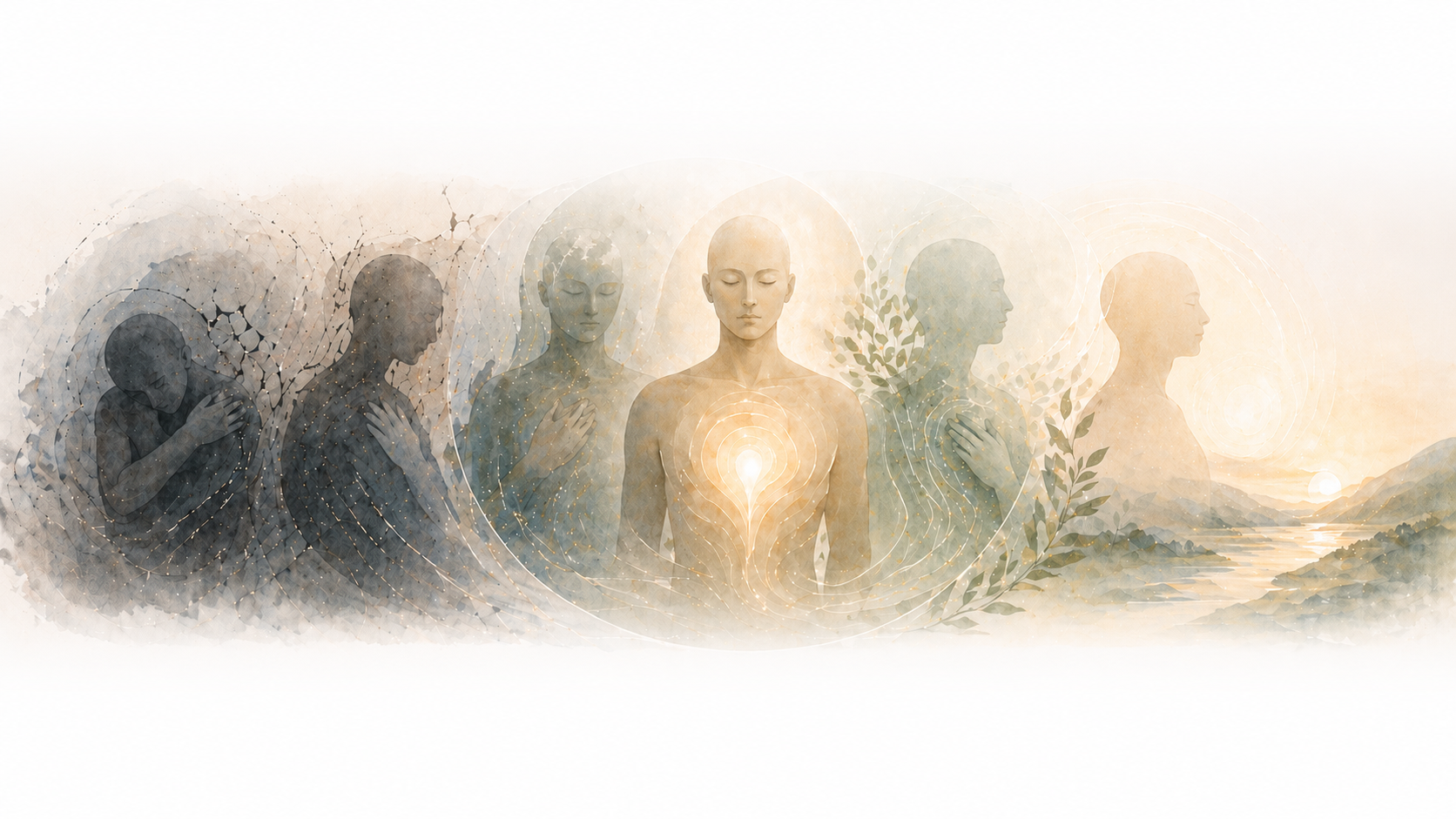
You may understand a reaction clearly and still find that your body responds automatically. Trauma-focused psychotherapy may attend to these bodily, emotional and relational patterns alongside reflection and meaning-making.
You may feel anxious, on edge, shut down, disconnected, easily overwhelmed, or unable to fully settle. You may also notice that something in you still responds as though safety cannot quite be felt yet.
Trauma does not always begin with one dramatic event, and it does not always look dramatic from the outside. It may show up through anxiety, shutdown, dissociation, people-pleasing, poor sleep, relationship difficulties, chronic tension, or a body that still expects danger.
It can also shape relationships, making trust, closeness, conflict, or emotional openness feel unexpectedly difficult.
This may be for you if
You may recognise that:
anxiety, shutdown, dissociation, or hypervigilance take over under stress
closeness, conflict, uncertainty, or emotional openness can feel unexpectedly threatening
previous therapy helped in some ways, while trauma-related difficulties remain active
You may also find yourself people-pleasing, withdrawing, bracing, avoiding, over-functioning, or trying to stay in control.
You do not need to be certain whether to call what you are experiencing “trauma”. Sometimes it is enough to begin with what is happening now: anxiety, shutdown, overwhelm, disconnection, tension, relationship patterns, or a sense that something in you still feels unsafe.
Trauma therapy often needs to move at a pace that allows you to remain sufficiently present without becoming overwhelmed or shut down. Rather than pushing quickly into painful material, the work begins by building enough steadiness for difficult experience to be approached without overwhelm, collapse, or shutdown.
Over time, the work may support more rest, steadiness, choice and connection, with less of life organised around managing threat.
If you would like to explore this further, the sections later on this page look more closely at the kinds of experiences that can have traumatic effects and how those effects may show up in the body, nervous system, relationships and everyday life.
If the shape of your symptoms feels more familiar than the word trauma itself, you may also want to read:
When another kind of support may be needed
Trauma therapy with me is not a rapid processing model, a short intensive programme, or a crisis service. This is especially important where someone has experienced attachment or developmental trauma, where the work often needs careful pacing, stabilisation, and attention to the therapeutic relationship over time.
I am not usually the right service for someone who is currently in acute crisis, needs frequent crisis support, requires out-of-hours care, or needs a level of support that weekly therapy alone cannot provide.
Sometimes the first task is not to begin trauma processing, but to understand what kind of support would be safest and most useful.
If you need urgent help now, feel unable to keep yourself safe, or need crisis support, please use urgent or emergency services rather than waiting for a therapy appointment.
How trauma therapy begins
Trauma-focused therapy begins carefully.
The first contact is usually a free 20-minute consultation, followed by early sessions where we build a shared understanding of what is happening, how symptoms, bodily responses and relationships are affected, and what kind of support should come first.
We do not need to go into traumatic experiences in detail at the beginning. The focus is on understanding the pattern, your current capacity, and how to work safely.
For a fuller overview of the first steps, you may want to read:
Practicalities
Sessions are available in person in Shinfield, Reading, Berkshire, and online via Zoom.
Access note: The Shinfield therapy room currently has no wheelchair access or accessible toilet. Please let me know if you have access requirements before arranging an in-person appointment.
Neurofeedback is available in person only.
Sessions are usually weekly, especially where marked activation, shutdown, dissociation or difficulty recovering after stress are part of the work.
Understanding trauma and its effects
Trauma can affect more than memory or emotion. It may shape how the nervous system responds to threat, how safety is felt in the body, how relationships are experienced, and how protective patterns develop over time.
The sections below explore some of these different layers. You do not need to recognise yourself in all of them for trauma-focused work to be relevant.
Explore the other sections below for more about how trauma can affect safety, development, relationships and the ways we adapt.
-
Some experiences are readily recognised as potentially traumatic: a serious accident, physical or sexual assault, a burglary or attack, war, an explosion, a medical emergency, witnessing violence, or suddenly finding yourself or someone else in serious danger.
But trauma does not always arise from one clearly identifiable event.
Sometimes the impact develops through experiences that happen repeatedly or over a long period of time. A single incident may appear relatively small from the outside, while the cumulative experience of having to endure it again and again can be very different.
This may include experiences such as:
repeated bullying, humiliation, intimidation or criticism;
ongoing abuse, coercion or controlling behaviour;
repeatedly feeling unsafe within an important relationship;
growing up around frightening, unpredictable or volatile behaviour;
emotional neglect or repeatedly being left without comfort, protection or support when it was needed;
having to monitor other people's moods or behaviour in order to stay safe or preserve connection;
repeatedly feeling unable to protest, escape, say no, or influence what was happening;
prolonged exposure to conflict, threat, instability or frightening circumstances.
Particularly in childhood, experiences such as these can become woven into development. There may be no single memory that seems sufficiently dramatic to explain the difficulties that emerge later. Instead, the person may have spent months or years adapting to an environment in which safety, protection, emotional responsiveness or predictability could not reliably be assumed.
This does not mean that every painful, difficult or imperfect experience is traumatic. People are affected differently, and the impact of an experience depends on many things: what happened, how often it happened, how long it continued, the person's age and vulnerability at the time, whether escape or protection was possible, and whether supportive relationships were available.
For this reason, it can sometimes be more useful to ask not only “Was there a traumatic event?” but also:
“What did you repeatedly have to adapt to, endure, or protect yourself from?”
Trauma-related patterns can develop around what happened once, what kept happening, and sometimes around what was repeatedly needed but unavailable.
-
Trauma often shows up as a nervous system that struggles to settle, soften or feel safe.
Some people live more in a state of high alert: scanning, bracing, startling easily, anticipating danger or finding it difficult to relax. Others are pulled towards shutdown: numbness, fog, sleepiness, collapse or a sense of being unable to mobilise.
Some people experience waves of panic. Others feel unreal, distant or disconnected from themselves or their body. Sleep, concentration, energy and emotional balance may also be affected.
For many people, the impact is relational. Trauma may show up through people-pleasing, withdrawal, conflict cycles, difficulty trusting, fear of closeness or losing a sense of yourself in relationships.
When threat is experienced, the body often responds before there is time to think. The nervous system may move into fight, flight, freeze, collapse, submit or appease.
You might recognise patterns such as:
going numb or not feeling much;
withdrawing, avoiding or people-pleasing;
perfectionism, over-responsibility or pushing through until you crash;
finding rest difficult, even when exhausted;
becoming overwhelmed by conflict, uncertainty or emotional intensity;
losing your sense of yourself in close relationships.
These patterns are not signs of weakness or failure. They may have developed as ways of managing threat, preserving connection or remaining functional.
Therapy can offer a place to understand them, recognise any protective function they may have, and explore where greater choice may become possible.
-
Trauma can affect how the nervous system receives and interprets sensory information.
After overwhelming experiences, the body may continue to scan for danger even when the present situation is safer. Sounds may feel sharper. Other people’s expressions may be read as threatening. The body may feel tense, numb, distant, braced or difficult to inhabit.
These responses often happen before conscious thought. The system may decide that something is unsafe before the mind has had time to make sense of it.
This is one reason trauma-focused individual psychotherapy may need to include the body, the nervous system and the felt sense of safety—not only thoughts, memories or explanations.
The aim is not to force the body to relax, but to help it recover more steadiness, orientation and choice.
In therapy, I do not force change or rush towards the most painful material. We begin with stabilisation, capacity and a pace that does not overwhelm the system.
-
Sometimes the effects of earlier experience are difficult to recognise because they become woven into ways of living that are highly functional, socially valued or simply understood as personality.
Someone may become exceptionally independent, hardworking, competent and good at solving problems. They may build a life around achievement, responsibility, continual learning or self-reliance and become the person others depend on.
None of these qualities, in themselves, indicate trauma. They may be genuine strengths. Sometimes, however, those strengths have also developed a protective function.
Staying busy may make aloneness or vulnerability less noticeable. Achievement may provide a reliable sense of worth. Being useful may help secure connection. Self-reliance may reduce the uncertainty involved in depending on others. Continually solving problems may create structure and control when stopping, not knowing or needing someone feels much harder.
Because these strategies work—and may work extremely well—their protective role can remain almost invisible. A person may not feel traumatised and may function successfully for many years.
Sometimes the adaptation is not experienced as a problem at all. During development, what feels safe, possible or available can gradually become narrower. A child may learn, for example, that needing less, staying useful, remaining quiet, being highly competent, keeping others happy or relying only on themselves works better than other ways of being. Because this happens gradually, the person may simply grow accustomed to living within those limits. What has become possible can feel like who I am, rather than one particular way of organising life.
The difficulty may therefore become visible not because the adaptation suddenly appears dysfunctional, but because its constraints begin to matter. A person may function very effectively while having little access to rest, dependence, vulnerability, spontaneity, receiving care, expressing need or tolerating uncertainty. It can be difficult to miss possibilities that have never felt genuinely available.
A strategy that once created safety can gradually become less of a choice.
Sometimes the pattern becomes clearer when life changes: work becomes quieter, a relationship ends, familiar structures fall away, other people become less available or the strategies that have kept life organised no longer work as effectively. The intensity of what then emerges can feel surprising because the adaptation had previously looked simply like personality, competence or the normal way of living.
For others, adaptation may look very different: people-pleasing, staying unnoticed, anticipating danger, emotional distance, being highly controlled or controlling, appearing endlessly easy-going, or finding it difficult to know what they themselves need.
Understanding this does not mean pathologising competence, ambition, independence, care for others, self-control or resilience. It means becoming curious about what our familiar ways of being help us manage, what they may protect us from, what they make possible—and what they may quietly make less possible.
This is one reason trauma-focused work can sometimes be relevant even when someone does not identify with the idea of being “traumatised” or cannot point to one obvious traumatic event. The question may be less “Was something terrible enough to count as trauma?” and more “What did I have to become, suppress or learn to do in order to feel safe, remain connected or keep functioning—and how much choice do I have now?”
-
The impact of trauma is not only about what happened.
It can also be shaped by:
the age or developmental stage at which it happened;
how long it continued;
whether it happened once or repeatedly;
whether it involved people who were meant to provide care;
whether enough support was available afterwards;
whether the person was left with shame, guilt, betrayal, self-blame or a painful conflict with their own values—sometimes described as moral injury.
Some trauma comes from sudden overwhelming events. Other trauma develops more gradually through repeated stress, fear, criticism, emotional neglect, instability, relational injury or long periods of needing to stay protected.
Developmental and relational trauma can shape the nervous system over time, particularly where there was little room to protest, escape, be believed or receive protection.
Trauma is shaped not only by the event, but also by the relationships, resources and possibilities surrounding it.
Two people may therefore experience similar events but be affected in very different ways. The meaning of the experience, the relationships surrounding it and what happened afterwards can all influence how the nervous system adapts.
-
Sometimes what a person is living with may be shaped not only by what happened directly to them, but also by what earlier generations had to survive.
The effects of trauma can travel through families in many ways: through attachment patterns, fear, silence around what happened, learned ways of anticipating danger and the wider social or cultural conditions in which people live.
This wider history may include:
war, persecution and forced displacement;
migration and loss of home or belonging;
racism and discrimination;
colonial, collective or historical trauma;
poverty, insecurity and structural adversity;
family secrets, silence and unresolved grief;
parenting patterns and family narratives shaped by earlier trauma.
Research also raises the possibility that severe stress may sometimes leave biological effects across generations, including through processes that influence how genes are regulated. The evidence is strongest in animal studies. Human research is still developing and does not show that trauma is simply or inevitably inherited.
History may shape us, but it does not have to determine us.
What happened to us—whether we remember it clearly, know only part of it or remain unaware of some of the influences that shaped us—does not have to determine our future.
Understanding these patterns can create more room for compassion, choice and change.
-
A psychedelic, spiritual or other altered-state experience can sometimes bring forward traumatic material, fear, shame, grief, dissociation, bodily activation or a sense of nervous-system overwhelm. Experiences that initially felt meaningful or opening can also leave someone confused, unsettled or struggling to integrate what happened afterwards.
Trauma-focused psychotherapy may be helpful where an altered-state experience has activated something that now continues to affect everyday life, relationships, sleep, emotional regulation or the sense of safety in the body.
Where appropriate, we can work carefully with experiences that have already occurred, including what emerged during the experience and what has remained difficult afterwards. The focus is on understanding and integrating what happened rather than trying to recreate or intensify the altered state.
I do not offer psychedelic-assisted therapy, preparation for substance use, dosing advice, facilitation, access to substances or support while someone is under their influence.
-
Many people worry that trauma-focused individual psychotherapy will require them to describe painful experiences in detail before they feel ready.
That is not how I work.Some people remember clearly what happened to them. Others have fragments, body sensations, emotional reactions or patterns they cannot fully explain. Some experiences happened too early to be held as a coherent memory. Sometimes there is no single event or story—only a growing recognition that something in the present still feels unsafe.
Trauma may show itself through pain, tension, shutdown, panic, dissociation or a sense of threat that is difficult to place. Early medical experiences, surgery, hospitalisation, separation, repeated procedures or longer periods of relational stress can sometimes contribute to this kind of nervous-system learning.
We may begin with what is happening now: anxiety, shutdown, emotional flooding, numbness, dissociation, bodily tension, sleep disturbance, relationship difficulties or the sense of never quite feeling safe.
The work may involve words, memories and meaning, but it is not only a talking process. We may also pay attention to body responses, protective strategies, relational patterns and the pace your system can manage.
You do not need to remember everything, explain everything or make everything fit into a complete story.
The aim is not to force traumatic material into the open. It is to create enough safety and steadiness for patterns held in survival to become more understandable and, where possible, begin to shift.
How trauma work may unfold
With support, time, and enough patience, the work may support greater flexibility, steadiness and recovery after stress.
In everyday life, that may mean less bracing, more rest, more emotional space, and more capacity to stay present under stress.
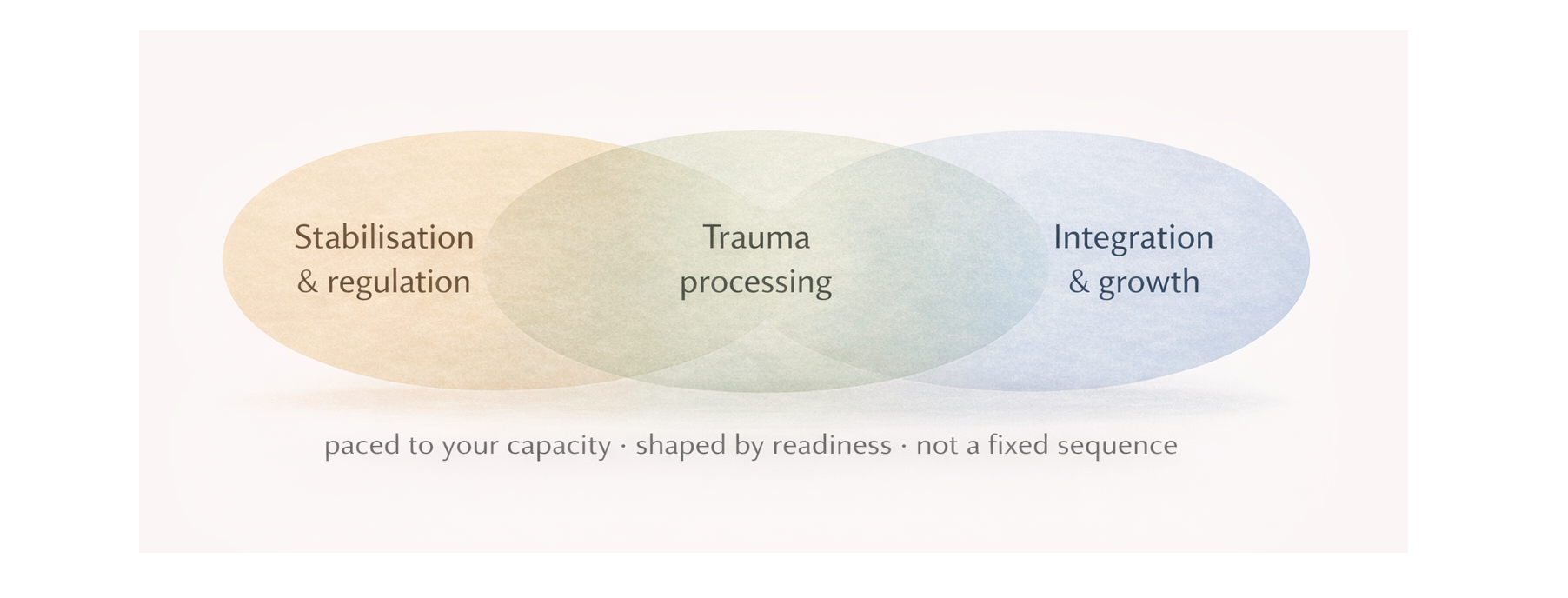
Trauma therapy often unfolds through three overlapping areas.
Stabilisation and regulation
Building enough steadiness, orientation, and capacity for the work to feel manageable. This may include understanding triggers, supporting sleep and arousal regulation, noticing early signs of overwhelm or shutdown, and strengthening what helps you return to the present.
Trauma processing
Carefully approaching traumatic material, body responses, protective patterns, and meanings when there is enough support to do so. This does not mean forcing disclosure or pushing quickly into painful memories.
Integration and growth
Supporting changes to become part of everyday life, relationships, self-understanding, and choice. This may include noticing when old reactions have less pull, strengthening boundaries, deepening self-trust, and finding new ways to relate to yourself and others.
These are not rigid stages. Sometimes the work focuses mainly on stabilisation for a while. Sometimes deeper processing becomes possible sooner. Sometimes we move back and forth between processing, reflection, regulation, and integration.
Where useful, I may also integrate Neurofeedback in person to support nervous-system regulation, particularly where sleep, overwhelm, reactivity, brain fog, or instability are making daily life or therapy harder to manage.
Read more about Neurofeedback ›
You may also find these pages helpful
Individual therapy ›
For a fuller sense of how I work in ongoing psychotherapy.
What I help with ›
If you recognise trauma more through anxiety, shutdown, dissociation, relationship patterns, exhaustion, or overwhelm.
Neurofeedback ›
If sleep, overwhelm, reactivity, brain fog, or nervous-system instability are making daily life or therapy harder to manage.
If you are considering trauma-focused therapy
A free 20-minute consultation can help us consider whether carefully paced trauma-focused work may be appropriate at this stage.
There is no pressure to continue.